
Work: RMN
Original sculpture
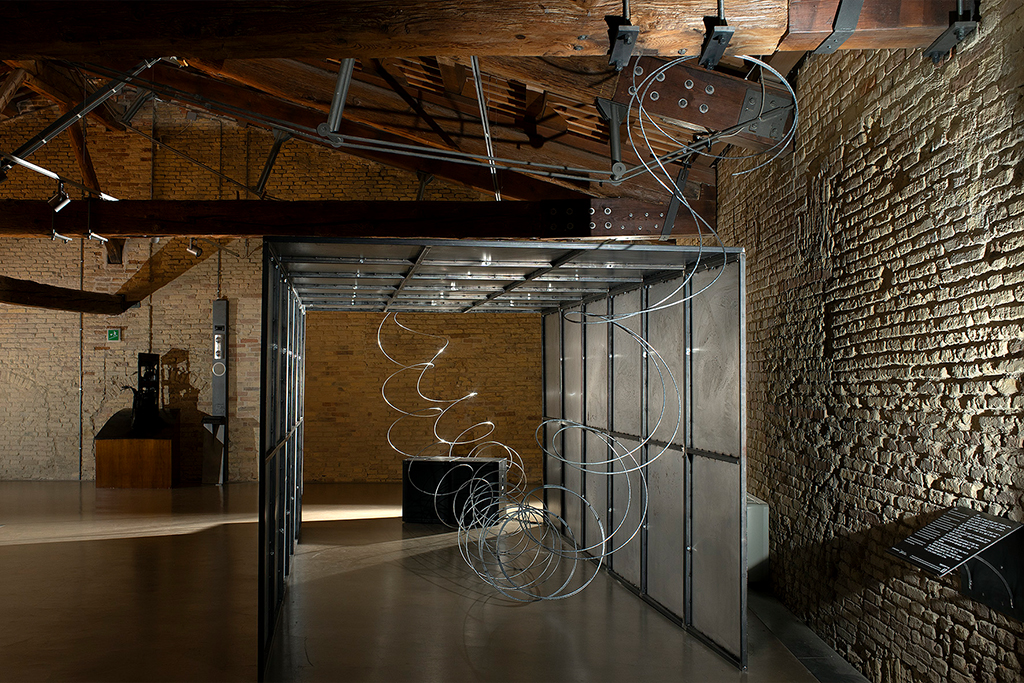
Original
- Date
- 2005
- Period
- Contemporary
- Dimensions
- dimension may vary depending on the characteristics of the surrounding space
- Technique
- sounding sculpture
- Material
- metal, sound
- Space
- 20th Century and Contemporary
Photo: Maurizio Bolognini. Museo Tattile Statale Omero Archive
Description
“I therefore consider the body as a physical mass, as a receptor: we all have a body. A body that, beyond any physical, ideological, political, religious, ethnic, age, sexual orientation, or dependency limit, can perceive an energy akin to a temperature, to a wind.” — Alberto Tadiello.
RMN is the winning artwork of the first edition of the Premio Omero (Omero Prize), an initiative born from the collaboration between the Directorate-General for Contemporary Creativity of the Ministry of Culture and the Museo Tattile Statale Omero (Omero State Tactile Museum) to promote multisensory and accessible works of art.
Created by Alberto Tadiello, RMN evokes the double meaning of the Italian acronym: Risonanza Magnetica Nucleare (Nuclear Magnetic Resonance / MRI) and Rete Mareografica Nazionale (National Tide Gauge Network).
RMN, created in 2005, is an invisible sound sculpture that is physically perceptible through the body, entering into a dialogue with the space in which it is installed. It is designed as an extremely flexible and versatile installation that can occupy a single room, multiple rooms, or wind through corridors. Inside the Museo Omero, it has been set up within an existing iron gallery that measures 6 meters long, 2.5 meters wide, and 2.30 meters high. At one end of the gallery, two black cubic speakers, measuring about 60 centimeters per side, are placed on the ground, emitting low-frequency sounds. These speakers, called subwoofers, transform sounds into vibrations felt primarily within bodily cavities, such as the stomach, head, and bones. The sound originates from a decoding system connected to the National Tide Gauge Network and tuned to the Ancona station, which updates every minute. The system transforms tidal trends into sound frequencies in real time. The only physical element and guide for the viewer is a pair of steel cables that form coils about 25 centimeters in diameter, swooping down from the ceiling and back up like a wave before and after the gallery.
One enters the artwork by crossing a threshold. The protagonist of the installation is the body, which perceives, moves through, and interacts with the gallery space, helping to define the artwork itself. RMN fully exists only when it is experienced. The experience is physical, personal, immersive, and does not require the use of sight.
Crucial to the project is the imaginative potential it sets in motion. Evoking the distance and displacement of enormous masses of water generates abstract concepts that become deeply subjective, carrying an intimate potential for interpretation. The artwork creates a connection between interior and exterior, between museum and city, between nature and technology: inside the Museo Omero and the Mole Vanvitelliana, RMN finds its ideal context.
Alberto Tadiello and His Poetics
Alberto Tadiello, born in 1983 in the province of Belluno, defines RMN as follows: “It is a work that tells of the courtship and attraction of physical masses: planetary, lunar, solar, human, beyond precise sensory limits or one’s own perceptual inclinations. It is a connection, a bridge between the viewer and the artwork, between the museum and the city, between space and the horizon of meaning. It is a vital, existential force that is perceived through one’s very being there, present to oneself. Feeling your stomach touched, without a hand pressing it, means being inside a force, witnessing an energy: you don’t need to see it—you cannot see it, you can only feel it. RMN is an empty space of freedom, like the sea, a mountain, the imagination.”
The artwork stems from his connection to Venice, the city where he completed his university studies, and from a personal medical journey involving MRIs, X-rays, and ultrasounds, each with its own images and language. The correlation between the timing of the excruciating pain of cluster headaches and variations in the Earth’s magnetic field triggered analogies and metaphors within him, deeply influencing his artistic research. Key features of his work focus on bodily depth and its enigmatic nature; touch, viewed in a global and all-encompassing sense that involves the entire body; and sound as the ultimate sculptural and symbolic material – an invisible organizer of reality and a creator of formal arrangements.
Tools for an Accessible Narrative of the Artwork
The Museo Omero, in collaboration with other partners, has created a series of accessible tools, which can also be accessed via QR codes on the caption label. Two are available in english:
- Braille transcription and audio description;http://youtube.com/watch?v=YNLiN6LRhZ8&feature=youtu.be
- Accessible videos produced by RAI Pubblica Utilità: one in Italian, with subtitles and Italian Sign Language (LIS) translation; one in English, with subtitles and International Sign translation;